What Is the Should I Do It Tool?
It is a two-step helper for one decision you keep going back and forth on, such as should I go, should I buy it, or should I send that message. First, four quick questions show which way your own answers lean. Then a fair flip gives you Do it or Don’t.
The two steps are shown side by side on purpose. The flip does not know anything about your situation, and the page never pretends it does. Its job is to give you an answer to react to. If the flip agrees with your lean and you feel relieved, you have your decision. If it disagrees and you feel let down, you have learned what you really wanted.
How to Use It?
It takes under a minute. Here is each step, with the part of the page it happens in.
-
Answer the gut check
Type what you are deciding if you like, then tap an answer to any of the four questions. The box underneath shows which way you lean and why, and updates as you go. Every question is optional.
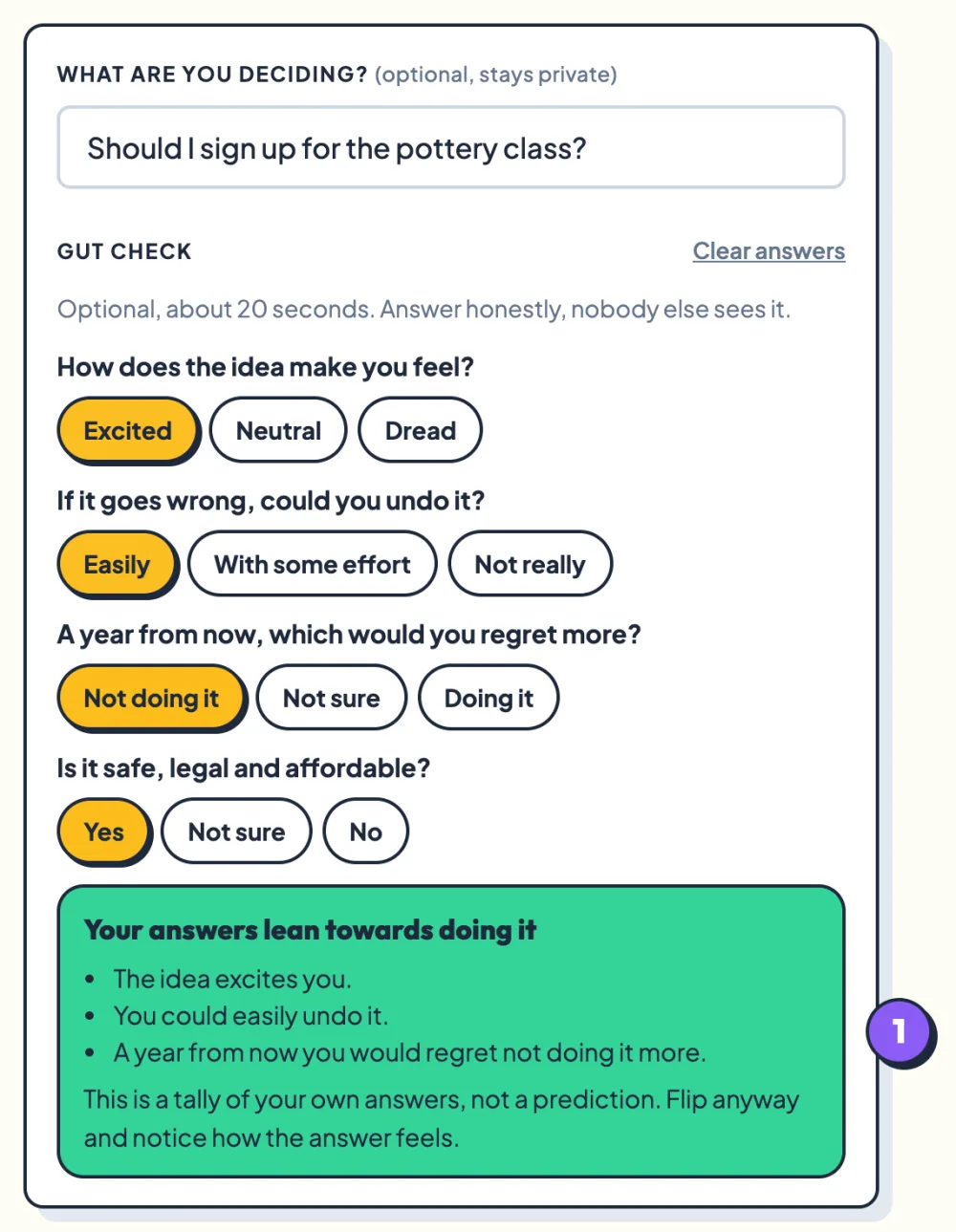
The lean is a tally of your own answers, with the reasons listed. -
Flip for it
Press Flip for it, press Space, or tap the card. It turns over to show Do it in a green circle or Don’t in a striped pink square.
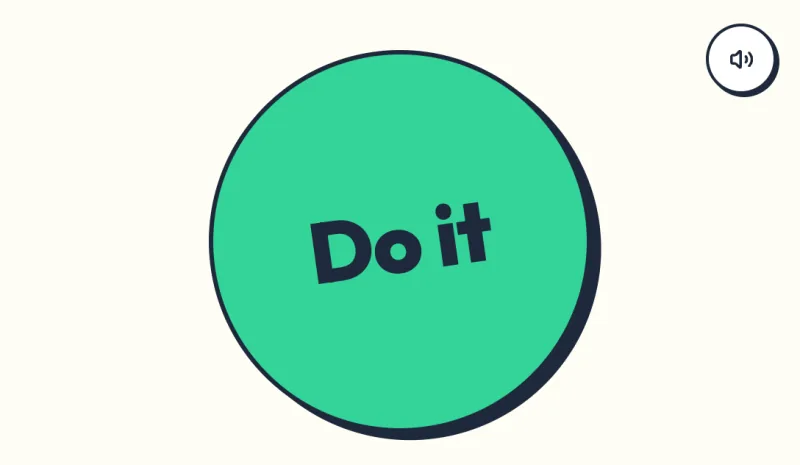
The answer is chosen before the card turns. -
Notice how it feels
The card below compares the flip with your lean and asks how the answer feels. Tap Relieved, Disappointed or Nothing much to see what your reaction means.
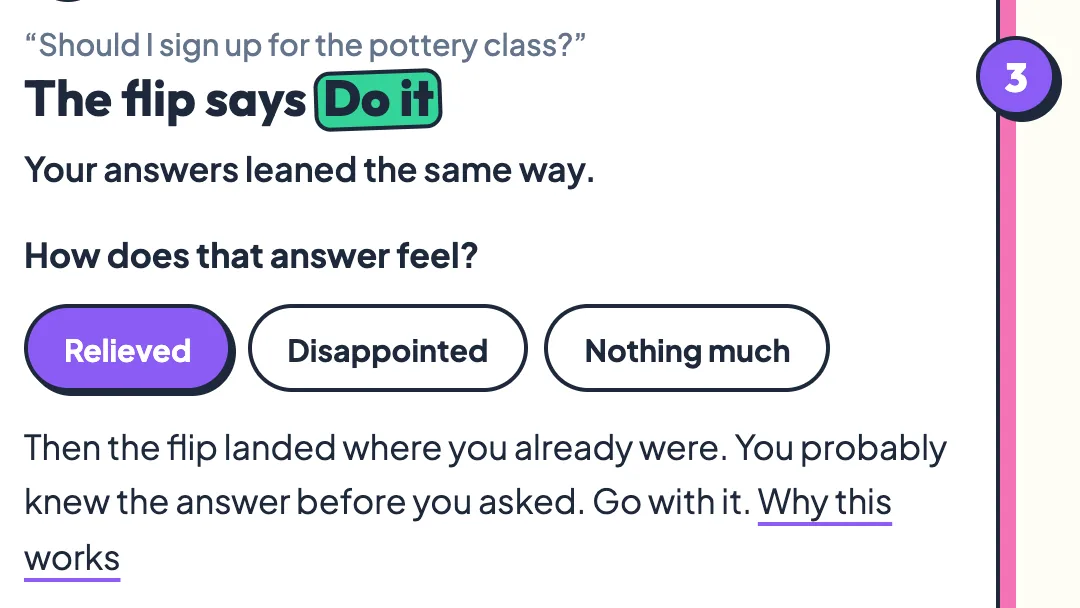
Share the result as an image, or ask a friend to flip on your question.
The Four Gut Check Questions
Each question covers one thing people tend to weigh when they are stuck. The answers are added up in plain sight, so you can see exactly why the box says what it says.
| Question | Answers and points | Why it is asked |
|---|---|---|
| How does the idea make you feel? | Excited +2, Neutral 0, Dread −2 | Your first feeling is information about what you want. |
| If it goes wrong, could you undo it? | Easily +1, With some effort 0, Not really −1 | Easy to reverse decisions are cheap to try. |
| A year from now, which would you regret more? | Not doing it +2, Not sure 0, Doing it −2 | Looking back from a year out puts today’s nerves in proportion. |
| Is it safe, legal and affordable? | Yes or Not sure, no points. No stops the flip | Some things should never be left to chance. |
A total of 2 or more leans towards doing it, −2 or less leans against, and anything in between is a toss-up. A toss-up is not a failure. It is the situation where a flip is most useful, because both options are close enough that the time spent deciding costs more than picking the slightly worse one.
The tally is deliberately simple. It is not a personality test or a prediction, and the points are not taken from a study. They are there to turn a vague feeling into something you can look at.
When Not to Flip
If you answer No to “Is it safe, legal and affordable?”, the Flip button switches off and the card fades. A random answer should never decide those questions, and the page will not pretend otherwise.
- Health, medication or anything risky to your safety.
- Money or legal commitments that are hard to undo.
- Choices that mainly affect someone else, unless they agreed to the flip.
For those, talk it through with someone you trust. Answering Not sure keeps the flip on but adds a reminder to check first.
Is the Flip Fair?
Yes. Do it and Don’t each have exactly a 1 in 2 chance. The answer is picked by your browser’s cryptographic random number generator, crypto.getRandomValues, before the card starts to turn. Your gut check answers never change the flip, they are only shown next to it.
Flip 10,000 times
Same code as the Flip for it button
The test flips 10,000 times and counts how often each answer came up.
The same random code runs the coin flip, where a million test flips came out at 50.038% heads.
Should I Questions That Work Well
The tool works best on everyday decisions where either choice would be fine and you are simply stuck. Some examples to start with.
Plans
- Should I go to the party or stay in tonight?
- Should I sign up for the class this term?
- Should I go on the trip with friends?
Buying things
- Should I buy it now or wait for a sale?
- Should I order the dessert?
- Should I upgrade my phone this year?
Messages
- Should I message them first?
- Should I reply tonight or tomorrow?
Habits and small changes
- Should I start running in the morning?
- Should I take a break from social media this week?
Word the question so that Do it means making the change. That keeps the answers consistent and matches how the best known coin flip study was set up, described below.
How to Get a More Useful Answer
Let Do it mean the change
In economist Steven Levitt’s study, people who were stuck on a decision flipped a virtual coin more than 20,000 times in all, where heads meant make the change. Six months later, the people who had made a change were substantially happier on average. If one option is the bolder move, let Do it stand for it.
Flip once
Wanting to flip again is a reaction too. It usually means the first answer was not the one you hoped for.
Watch your reaction, not the card
Psychologists Jaffé, Reutner and Greifeneder found that a coin flip made people’s feelings about the options stronger, and that people often decided by that feeling. Both studies are explained in full on the Yes or No Wheel page.
Need Another Way to Make a Decision?
We Want to Hear Your Feedback
Is there a gut check question you would add, or one that never helps? Every message is read, and the best ideas end up on the page.
Email usYou can also reach us through the contact page.
Frequently Asked Questions
Is the Should I Do It flip random?
Yes. The flip is picked by your browser's cryptographic random number generator before the card turns, with exactly a 1 in 2 chance of Do it and of Don't. Your gut check answers do not change it. You can check it with the 10,000 flip test on this page.
How does the gut check work?
Each answer adds or takes away points. Excited counts plus 2 and dread minus 2, easy to undo plus 1 and hard to undo minus 1, and regretting not doing it plus 2 while regretting doing it counts minus 2. A total of 2 or more leans towards doing it, minus 2 or less leans against, and anything in between is a toss-up. It is a tally of your own answers, not a prediction.
Why can't I flip after answering No to safe, legal and affordable?
Because a random answer should never decide something that is unsafe, illegal or that you cannot afford. The Flip button switches off until you change that answer, and the page suggests talking it through with someone you trust.
Should I do what the flip says?
Not necessarily. The flip is most useful for the reaction it causes. If the answer feels like relief, you probably wanted it. If it feels like disappointment, you were hoping for the other one. Either way, the decision stays yours.
Is my question or my gut check saved anywhere?
No. Your question and your gut check answers stay in your browser and are never sent to our server. Analytics only records which of the fixed answer buttons were tapped, never anything you typed. If you use Ask a friend, your question travels inside the link after a # sign, which browsers never send to a server.
How is this different from the Yes or No Wheel?
The wheel gives a fast random yes or no to any question. This page is for one decision you are unsure about. It asks four quick questions first, shows which way your own answers lean, and then flips Do it or Don't so you can compare the two.
Sources
- Levitt, S. D. (2016). Heads or Tails, The Impact of a Coin Toss on Major Life Decisions and Subsequent Happiness. NBER Working Paper 22487. Summarised in To Change, or Not to Change? Just Flip a Coin, NBER Digest, October 2016.
- Jaffé, Reutner and Greifeneder (2019). Catalyzing decisions. How a coin flip strengthens affective reactions. PLOS One.
- MDN Web Docs. Crypto.getRandomValues() method.