What Is This Coin Flip?
This is a free online coin toss. Flip it for heads or tails, or switch it to Yes or No and ask it a question. You can flip once, or play best of 3 or best of 5 when one flip feels too sudden.
Unlike a real coin, this one has no favourite side. A large study of real coin tosses found they land on the side they started from slightly more often than half the time. Here the side is picked by your browser's cryptographic random number generator before the coin leaves the table, so where it started makes no difference. You can test that further down the page.
How to Use It?
A flip takes about two seconds. Here is each step, with the part of the page it happens in.
-
Type your question
If you are deciding something, type it in the box, such as “Should we go to the beach today?” This is optional. For a plain heads or tails, skip it.

Your question stays in your browser. -
Choose what the sides mean
Leave it on Heads or Tails for a classic toss, or pick Yes or No so heads means Yes and tails means No. Then choose to flip once, best of 3 or best of 5.
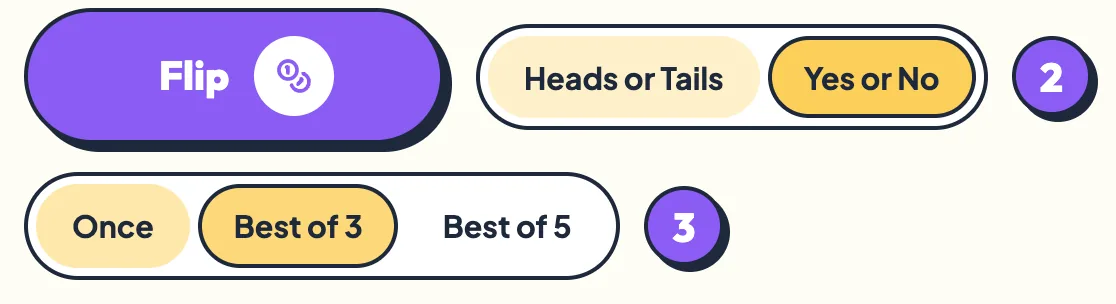
The selected options turn yellow. -
Flip the coin
Press Flip, press Space on your keyboard, tap the coin, or swipe up on it to toss it. The coin spins up into the air, falls back and lands with a clink.
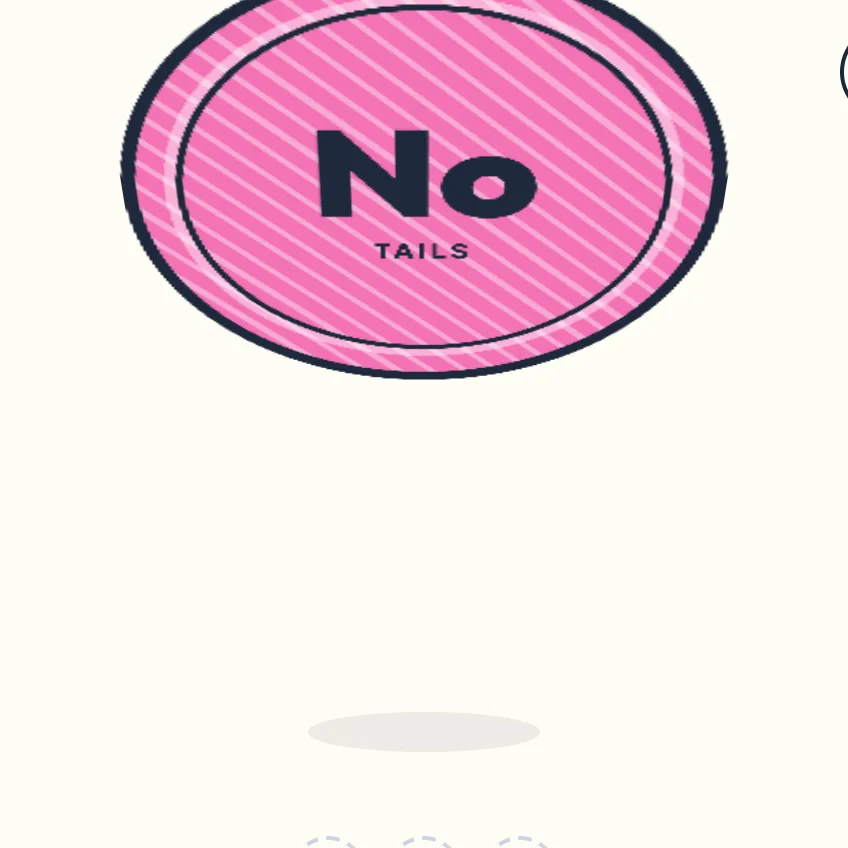
The coin in the air. The side it lands on was decided before it left. -
Read the result
The coin settles face up and the card below shows the result with your question. In best of 3 or best of 5, a row of markers fills in after each flip until one side wins.
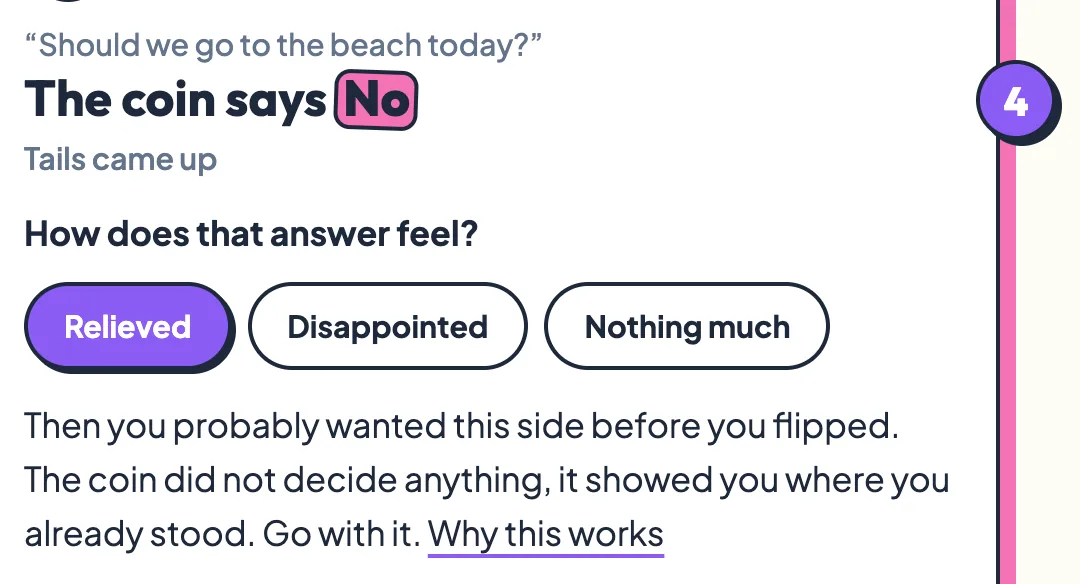
Tap Relieved, Disappointed or Nothing much to see what your reaction means.
Heads or Tails, or Yes or No
The coin has two modes, and they use exactly the same 50/50 toss.
- Heads or Tails. The coin shows H and T, for calling a toss, starting a game or settling who goes first.
- Yes or No. The faces read Yes and No, and the result card answers your question directly. Heads is always Yes.
Pick the mode before you flip. Deciding which side means what after you see the result defeats the point.
Best of 3 and Best of 5
A single flip can feel too abrupt for something that matters a little. Best of 3 keeps flipping until one side has won twice, and best of 5 until one side has won three times. A row of markers under the coin fills in after each flip so everyone can follow the score.
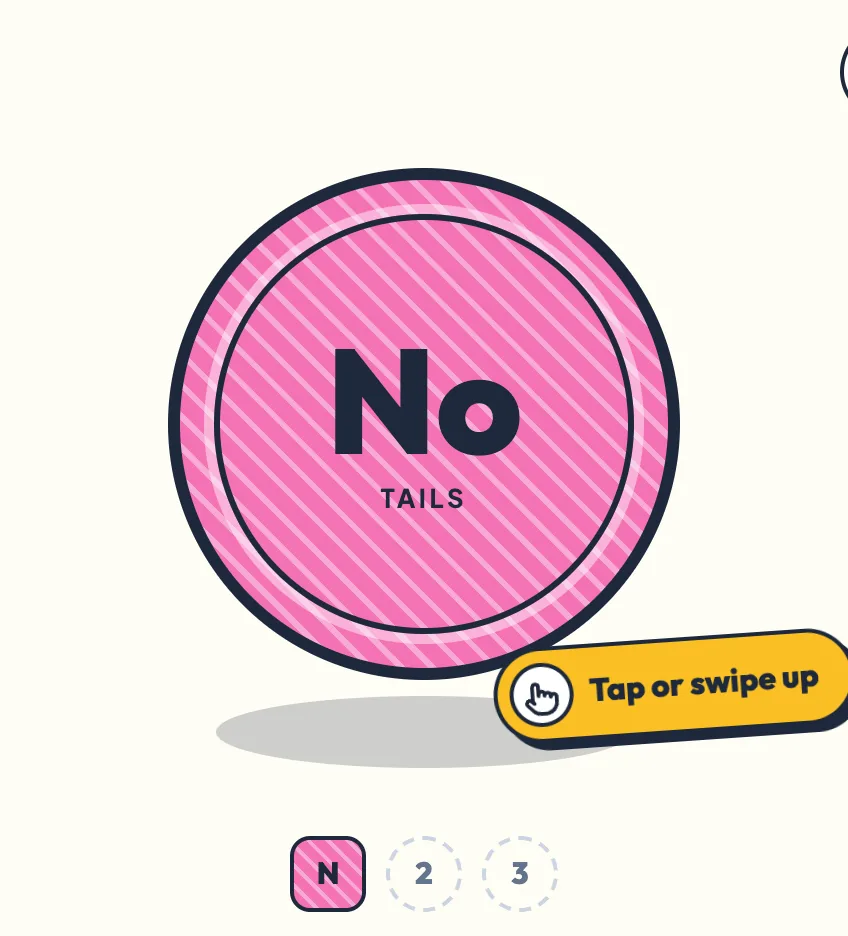
Best of 3 does not change the odds. Each side still has exactly an even chance of winning the series. It only stretches the moment out, which gives your reaction more time to show.
Tap or Swipe to Toss
On a phone, flick your finger upward on the coin to toss it, like flicking a real coin off your thumb. A quick tap on the coin flips it too, and on a computer you can click it or press Space.
The swipe is for feel only. The side was picked before the coin moved, so a harder flick cannot steer it.
Share Results
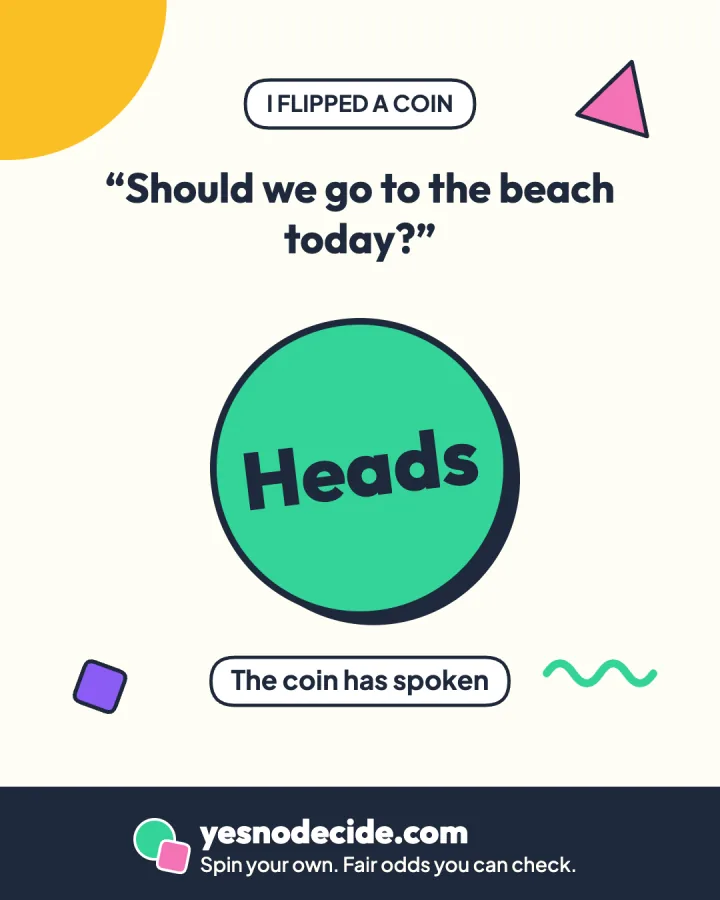
After a flip, press Share result to turn it into an image with your question and the result. On a phone it opens your share menu, and on a computer it downloads. The image is drawn in your browser and nothing is uploaded.
Is a Coin Flip Really 50/50?
Not quite, if the coin is real. In a 2023 study led by František Bartoš, 48 people flipped coins minted in 46 countries a total of 350,757 times. The coins landed on the same side they started on 50.8% of the time.
The study set out to test a prediction from a physics model by Diaconis, Holmes and Montgomery, which says an ordinary tossed coin tends to land on the side it started on. The data agreed. There was no bias between heads and tails themselves, which came up 50.0% each. The lean is toward whichever side was facing up at the start, and it varied slightly from one person to the next.
Why this coin has no favourite side
Here, the side is chosen by your browser's cryptographic random number generator, crypto.getRandomValues, before the toss begins. The animation is then drawn to land on that side, whichever face was up beforehand. It is the same code that picks the answer on the Yes or No Wheel, so each side is exactly 1 in 2.
Flip 100,000 coins two ways
This coin against a real coin
The test flips this coin 100,000 times, then simulates 100,000 tosses of a real coin that started heads up and keeps its starting side 50.8% of the time.
Over 100,000 flips the gap is clear. A fair coin stays within about 0.3 percentage points of 50%, while the simulated real coin settles near 50.8% heads. In a single real toss you would never notice, but it is the honest reason a virtual coin can be fairer than the one in your pocket.
When to Flip a Coin?
Choosing between two options
When two choices are equally good, a coin is the fastest fair way out. Order in or go out, this film or that one, left or right.
Deciding who goes first
Board games, card games, kick-offs and turn order. Everyone can watch the same screen, so nobody can claim the toss was rigged.
Probability lessons
Teachers use coin flips to show how chance behaves. Ask the class to predict how often three heads in a row will happen, then flip and count. The fairness test above makes a ready-made demonstration of how big samples settle down.
When you cannot make up your mind
If you are stuck on a yes or no decision, switch the coin to Yes or No and flip. The next section explains why the result can help even if you do not follow it.
How to Get a More Useful Answer
Assign the sides first
Say out loud which option heads stands for before you flip. If you decide afterwards, you are not really flipping, you are just picking.
Let heads mean change
In economist Steven Levitt's study, people who were stuck on a decision flipped a virtual coin, more than 20,000 times in all, where heads meant make the change. On important decisions, those who made a change reported being substantially happier six months later. So when one option is the bolder move, let heads stand for it.
Watch your reaction
Psychologists Jaffé, Reutner and Greifeneder found that flipping a coin made people's feelings about the result stronger, and that people often decided by that feeling rather than by the coin. If the result disappoints you, you were hoping for the other side. Both studies are explained in full on the Yes or No Wheel page.
Coin Flip Games
A shared screen and a loud clink turn a coin into a party game. Three that work well:
- Call it. Everyone calls heads or tails before each flip. Wrong calls are out, and the last player standing wins.
- Streak challenge. Each player flips until the side changes. Longest streak wins. A streak of 5 happens about 1 time in 16, so expect a few surprises.
- Best of 5 showdown. Two players take a side each and play best of 5. The markers under the coin keep score.
Need Another Way to Make a Decision?
Yes or No WheelSpin a wheel for Yes, No or Maybe, from 1 to 12 sets, with flick to spin, full screen and the same fair odds.We Want to Hear Your Feedback
Found a bug, have an idea for the coin, or want a new decision tool? Every message is read, and the best ideas end up on the page.
Email usYou can also reach us through the contact page.
Frequently Asked Questions
Is this coin flip really 50/50?
Yes. The side is picked by your browser's cryptographic random number generator before the coin is tossed, with exactly a 1 in 2 chance for each side. You can check it with the 100,000 flip test on this page.
Is a real coin flip fair?
Almost. A 2023 study of 350,757 real coin flips found that coins land on the side they started on about 50.8 percent of the time. Heads and tails themselves came up equally often.
Does heads come up more often than tails?
No. In the same study heads and tails each came up 50.0 percent of the time. The small bias is toward whichever side starts face up, not toward heads.
Which side of the coin should mean yes?
In Yes or No mode, heads always means Yes on this coin. Whatever you use, decide what each side means before you flip, not after.
Does best of 3 change the odds?
No. Each side still has exactly an even chance of winning the series. Best of 3 and best of 5 only take longer, which can make the result feel more settled.
Why did I get tails five times in a row?
Because streaks are normal. Any five flips all land the same way about 1 time in 16. The coin has no memory, so five tails in a row make the next flip no more likely to be heads.
Is my question saved or sent anywhere?
No. Your question stays on this page, in your browser, and is never sent to our server or our analytics. If you use Ask a friend, it travels inside the link after a # sign, which browsers never send to a server.
Sources
- Bartoš, F., Sarafoglou, A., Godmann, H. R. and colleagues (2023). Fair coins tend to land on the same side they started. Evidence from 350,757 flips. arXiv 2310.04153.
- Phys.org (October 2023). Flipped coins found not to be as fair as thought.
- Levitt, S. D. (2016). Heads or Tails, The Impact of a Coin Toss on Major Life Decisions and Subsequent Happiness. NBER Working Paper 22487. Summarised in NBER Digest, October 2016.
- Jaffé, Reutner and Greifeneder (2019). Catalyzing decisions. How a coin flip strengthens affective reactions. PLOS One.
- MDN Web Docs. Crypto.getRandomValues() method.